
7 Best Solar Powered Luxury Watches in 2026
Looking for elegance that never needs a battery change? This guide to solar powered luxury watches compares real, current models — from Swiss GPS-solar to Japanese Eco-Drive — so you can choose a low-maintenance timepiece that looks premium and holds up for years. Updated for 2026 with the latest brand news.
Luxury That Recharges Itself
In high-end horology, innovation usually means a novel movement or an exotic material. Solar powered luxury watches offer a different kind of innovation: a translucent dial captures light and feeds an ultra-efficient quartz or GPS-synced system, so the watch stays accurate for months without a battery swap. Interest in this category has grown noticeably in Pakistan too, alongside demand for mechanical staples — if you’re comparing categories, our guide to the Audemars Piguet price in Pakistan is a useful reference point for where solar sits against traditional luxury pricing.
Premium makers have moved solar from “tool watch” territory into genuine statement pieces — sapphire crystals, titanium cases, and Swiss or Japanese finishing now sit alongside GPS time sync and multi-year power reserves.
What’s changed most in the last few years isn’t the basic technology — light hitting a photovoltaic cell under the dial has worked the same way since 1976 — but how well brands hide it. Early solar watches were easy to spot because the cell required a visible grid pattern on the dial. Today’s dials use tinted glass, textured finishes, or layered construction that lets light through without any obvious clue the watch is solar at all, which is part of why the category has finally earned a place in serious luxury conversations rather than staying in the “practical but plain” bracket.
What’s New in Solar Watches This Year
2026 is a genuinely significant year for this category. It marks the 50th anniversary of Citizen’s Eco-Drive technology — the brand’s original 1976 Crystron Solar Cell was the world’s first light-powered analog watch. To mark the milestone, Citizen released the Eco-Drive Photon, built on a new Cal. E036 movement rated for a 365-day power reserve on a single charge.
Just as notable: Swiss brand Victorinox entered the solar watch category for the first time in April 2026, launching four solar references within its Concept One line, powered by a Ronda 215 solar movement with an estimated eight-year cell life. It’s a sign that solar is moving further into mainstream Swiss watchmaking, not just Japanese quartz specialists.
The Victorinox move matters beyond the specific watches involved. When a 140-year-old Swiss brand best known for pocket knives and field-ready mechanical pieces adds solar to its lineup, it signals that low-maintenance charging technology is no longer seen as a compromise on “serious” watchmaking credentials — it’s being treated as a legitimate engineering choice alongside automatic and manual-wind movements, not a budget alternative to them.
Why Choose a Solar Luxury Watch?
1) Effortless Power
Modern solar calibres store months of energy on a full charge — some 2026 models now reach a full year. Daily wear under normal indoor lighting keeps the cell topped up.
2) Precision You Can Trust
High-grade solar quartz and GPS-synced models deliver ±5 to ±15 seconds/month accuracy, and some auto-sync with satellites for correct time anywhere.
3) Lower Lifetime Cost
Fewer services, fewer surprises. The rechargeable cell itself typically lasts 10–20 years before needing replacement, versus 2–5 years for a standard quartz battery.
4) Sustainable by Design
Choosing solar means less battery waste over the watch’s lifetime, and current designs hide the solar layer so you get the aesthetics without any visible “tech” look.
How Solar Charging Works
A translucent dial lets light pass through to a thin photovoltaic layer underneath, which converts light into electrical energy stored in a rechargeable cell. Efficient circuits then draw from that cell to drive the hands. You don’t need direct sunlight — normal indoor lighting or a few minutes near a window each week is usually enough to keep most solar watches fully charged.
Efficiency has improved dramatically since the technology launched. Early Eco-Drive movements needed roughly 80% of available light to pass through the dial to charge properly; current-generation movements need as little as 15%, according to Citizen’s own engineering data released around its 2026 anniversary. That efficiency gain is the real reason today’s solar dials can look completely conventional — the cell simply needs far less exposed surface area to do its job.
Top 7 Solar Powered Luxury Watches in 2026
Each pick below suits a different use case — dressy minimalism, travel accuracy, hybrid smart features, or rugged everyday wear.
1) TAG Heuer Aquaracer Professional 200 Solargraph
Best for: Luxury dive style with discreet solar tech
TAG Heuer’s Solargraph brings Swiss build quality to solar charging in a 40mm case with 200m water resistance. The dial’s fine texture hides the solar layer entirely.
View on TAG Heuer →2) Seiko Astron GPS Solar
Best for: Frequent flyers who want accurate time everywhere
Astron pioneered the luxury GPS-solar category — satellite time sync, world time, and refined titanium or steel casework make it a genuine travel companion. If you’re weighing it against a mechanical GMT for travel, see our luxury GMT watches 2026 guide for comparison.
Compare investment-grade brands →3) Citizen Eco-Drive Photon (50th Anniversary)
Best for: Buyers who want this year’s most significant solar release
Released in 2026 to mark 50 years of Eco-Drive, the Photon runs on Citizen’s new Cal. E036 movement with a 365-day power reserve — the longest in the brand’s lineup — in a Super Titanium case.
View on Citizen →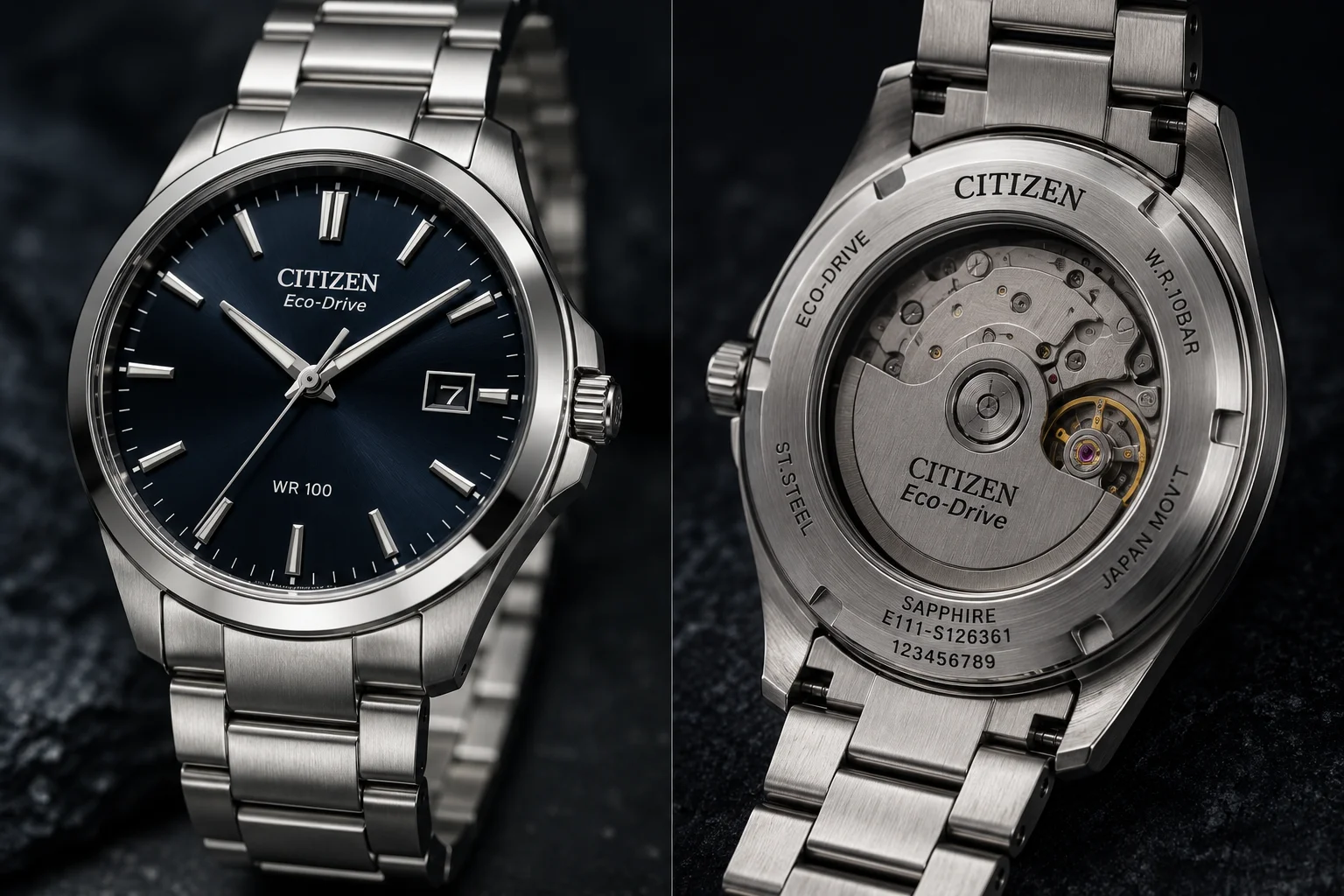
4) Victorinox Concept One Solar
Best for: Buyers who want the newest Swiss entrant to solar
Victorinox’s first-ever solar watches, launched April 2026, run on a Ronda 215 solar movement with an estimated eight-year cell life, in a 39mm steel case with 100m water resistance and magnetic resistance.
See first-luxury-watch picks →5) Tissot T-Touch Connect Solar
Best for: Hybrid smart features in a Swiss titanium package
The T-Touch series adds discreet smart functions — compass, altimeter, notifications — without losing the feel of an analog field watch, backed by solar charging for long trips.
Browse budget-friendly options →6) Junghans Max Bill MEGA Solar
Best for: Minimalist Bauhaus design with radio-controlled precision
Understated and architectural, the Max Bill MEGA Solar hides serious tech under a pure dial, with radio time reception keeping accuracy sharp in a featherlight titanium or steel case.
See entry-level luxury picks →7) Casio Oceanus Manta (Tough Solar)
Best for: Thin, dressy, and quietly over-engineered
Oceanus blends Japanese refinement with Tough Solar and Bluetooth time sync in a remarkably slim titanium case — under-the-radar luxury at its most technical.
Compare against traditional Rolex pricing →How to Choose the Right Solar Luxury Watch
1) Lifestyle & Use Case
Traveling often? GPS-solar (Astron, Citizen). Boardroom plus weekend diving? TAG Heuer Solargraph. Want this year’s newest release? Citizen Photon or Victorinox Concept One.
2) Case Materials
Titanium cuts weight noticeably on larger cases. Sapphire crystal is worth insisting on for scratch resistance regardless of price point.
3) Accuracy & Sync
GPS and radio-controlled models correct themselves automatically, which matters if you rotate watches and don’t want to reset time by hand each time.
4) Water Resistance
200m for real diving confidence. 100m comfortably covers swimming and daily life. 50m is fine for a dress piece worn mostly indoors.
5) Power Reserve
Reserves now range from 6 months to a full year depending on the movement — check this figure specifically if you plan to store the watch for long stretches.
6) Budget Tier
Not ready for four figures? Start with our best watches under $1,000 or affordable luxury under $500 guides.
One filter worth adding to the list above: resale and service support. Established GPS-solar lines like Astron and Eco-Drive have deep parts availability and independent watchmakers who know the movements well, which matters if you plan to keep the watch for a decade or more. Brand-new entrants like Victorinox’s Concept One are promising on paper, but as first-generation solar references, they don’t yet have the same long-term service track record — worth factoring in if long-term reliability matters more to you than being an early adopter.
Care & Maintenance
- Light routine: Regular ambient light — a desk lamp or a window — is enough to maintain charge.
- Storage: If boxed long-term, expose it to light every couple of weeks.
- Water care: Rinse after saltwater exposure; check gaskets every few years if you swim often.
- Accuracy checks: GPS/radio models self-correct; others are worth checking against your phone monthly.
If a solar watch has been sitting unused for an extended period and won’t run even after fresh light exposure, don’t assume the cell is dead — most modern movements have a deep power-save mode that can take several hours of direct or bright indirect light to fully wake from before the hands start moving normally again. Give it a full day near a window before concluding anything is actually wrong.
Frequently Asked Questions
Do solar powered luxury watches ever need a battery replacement?
The rechargeable cell is built for very long life — typically 10 to 20 years — so replacement is rare and far less frequent than a standard quartz battery swap.
How long will a full charge last?
Most premium models store 6 to 12 months of power reserve; Citizen’s newest 2026 Eco-Drive Photon movement is rated for a full 365 days.
Can indoor light really charge the watch?
Yes — modern solar modules are efficient enough that bright indoor lighting and daylight through a window provide ample charge for daily wear.
Are solar watches as accurate as mechanical ones?
Typically more accurate. Expect roughly ±5 to ±15 seconds per month for high-end solar quartz, and near-exact time on GPS or radio-synced models.
What’s new in solar watches for 2026?
Citizen marked 50 years of Eco-Drive with the Photon’s 365-day-reserve movement, and Victorinox launched its first-ever solar watches in April 2026 — both signal solar moving further into mainstream Swiss and Japanese watchmaking.
The Smartest Low-Maintenance Luxury Upgrade
If you want a watch that stays accurate, needs almost no maintenance, and quietly supports a cleaner ownership cycle, solar powered luxury watches are an easy recommendation heading into 2026. Choose the Aquaracer Solargraph for a refined diver, Astron or Citizen Photon for flawless everyday accuracy, or the new Victorinox Concept One if you want this year’s freshest release.
Disclosure: Availability, specs, and pricing may vary by region and change over time. Some models mentioned are limited editions and may sell out.